|
|
EditRegion3
| |
June 2026 "My First Supernova"
|
Supernova SN2926 kid in NGC5907
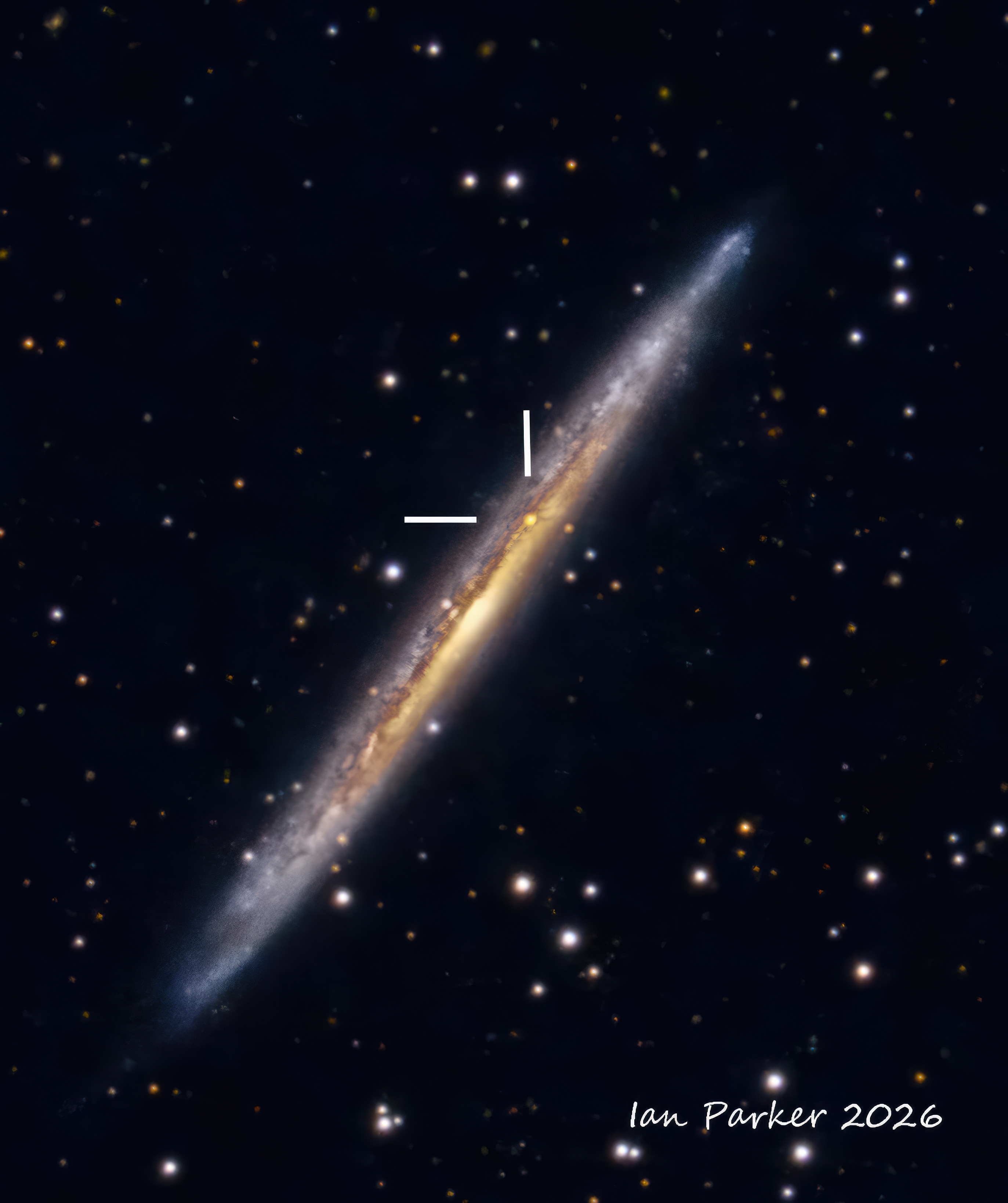
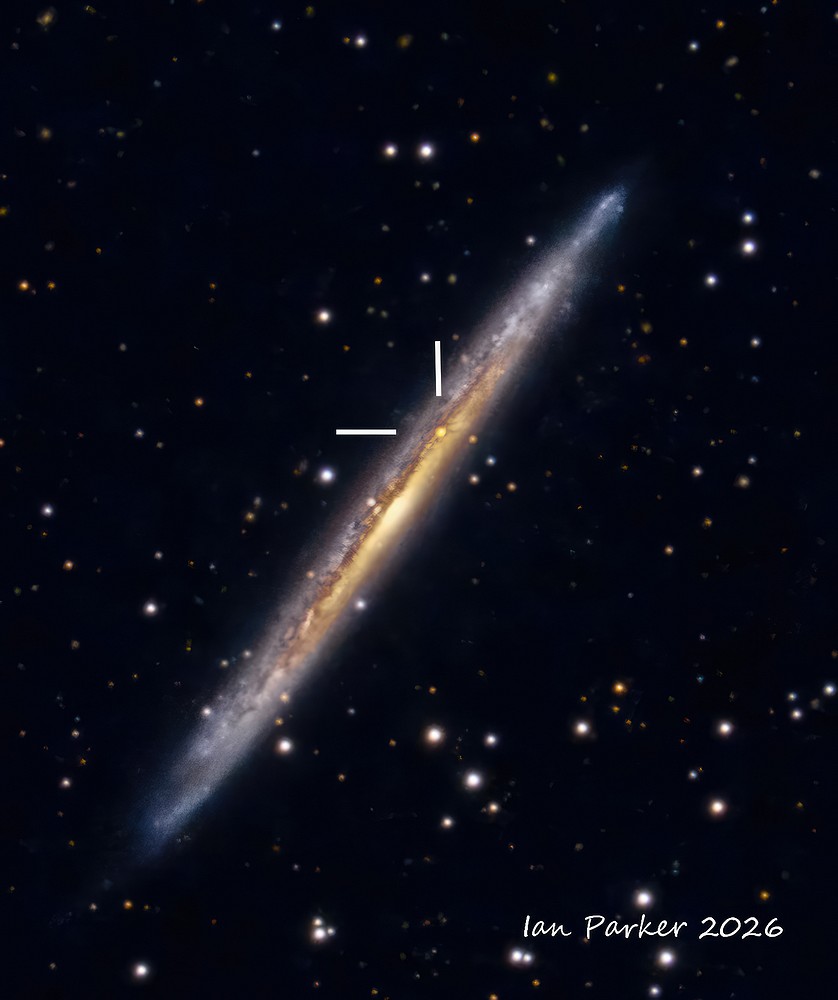
A long time ago, far away in a distant galaxy, a massive star was destroyed in a supernova explosion. It took about 50 million years for the light from this explosion to reach us then, as viewed from earth, an apparent new star appeared on April 22nd, 2026. The supernova (catalogued as SN2026kid) occurred within the Splinter galaxy (NGC5907). As it happened, I had chosen this galaxy as the target for my telescope several days later, but at the time I was unaware of the supernova. Looking at my image, I took no special notice of a small yellowish dot about at the mid-line of this edge-on, spiral galaxy: it might just have been a coincidental alignment of a star in our own galaxy. But then on May 7th the Astronomy Picture of the Day website published an amazing timelapse video of the Splinter galaxy, taken by an amateur astronomer*, showing the sudden appearance of a supernova. Checking my photo of the galaxy, the yellow dot indeed matched the location of the supernova.
Supernovas arise either as a massive star runs out of fue (as with SN2026kid), ceasing to generate fusion energy in its core, and collapsing inward under the force of its own gravity to form a neutron staror a black hole; or when a white dwarfstar accretes material from a companion star until it reaches a critical mass and undergoes a carbon detonation. Releasing as much energy as our Sun will emit over its entire 10-billion-year lifetime, a single supernova is one of the most powerful and energetic events in the universe. To put that in perspective, the energy released (~10^44 Joules) is about 200 septillion (2 x10^26) times greater than the most powerful hydrogen bomb ever exploded. The light of a supernova may briefly outshine its host galaxy, and a supernova within our galaxy may even be visible on earth during daytime. The reason why SN2026kid does appeardimmer than this is likely because it lies deep within the galaxy so that its light is obscured by dark dust lanes from our side-view perspective.
Unfortunately, I was not imaging the Splinter galaxy on the crucial night, and I don’t have a ‘before’ image to compare. However, after reaching a peak luminosity within days supernova emission typically declines over months or a few years. When the galaxy comes round again next spring I will see if I can get an ‘after’ image with the supernova absent or markedly dimmed. Supernovae are one of very few things in deep space that change over a human timescale or even over thousands of years
.
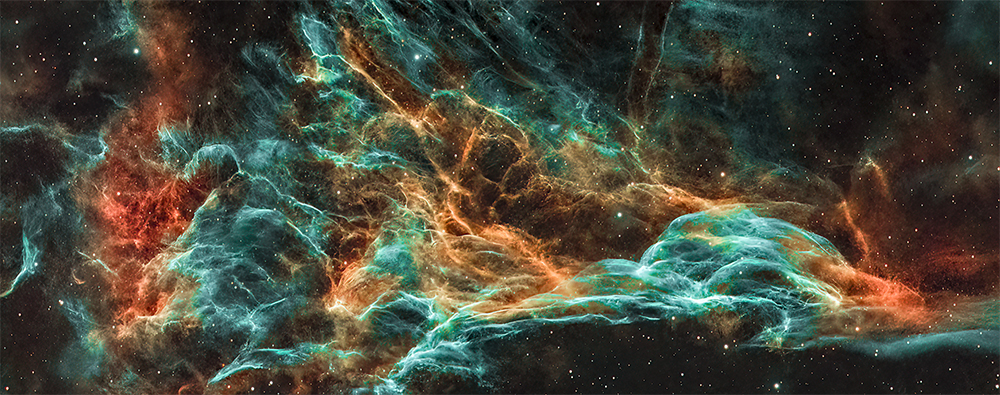
Another thing that does change on a cosmically rapid scale is the debris left behind after a supernova. A supernova remnant (SNR) is bounded by an expanding shock wave and consists of ejected material expanding at ~10% the speed of light from the explosion, together with the interstellar material it sweeps up along the way. The shock wave ahead of the ejecta heats the upstream plasma to temperatures well above millions of K, creating intricate filaments that glow primarily at wavelengths of ionized hydrogen, oxygen and sulphur. SNRs expand over hundreds or thousands of years before finally fading. During their lifetime they are perhaps the most aesthetically beautiful and colorful deep sky objects. SN2026kid is so far away that its SNR may never be visible from earth. But supernovas occur about every hundred years within a galaxy like the Milky Way, so despite their limited lifetime there are many “nearby” SNRs to keep astrophotographers occupied. Maybe I can hope to seer a nearby supernova within my lifetime.
*What is the chance that an amateur astrophotographer caught the supernova? Probably quite high. To get good quality images from faint galaxies it is necessary to collect the light from numerous sequential exposures during the night, and sometimes over several nights. These individual exposures are normally stacked and integrated together to produce a final, high quality image, but in the case of a transient event they can be played back as a time-lapse movie. In this instance, the astrophotographer (Hunter Outten) was trying to capture very faint tidal tails of dust around the Splinter galaxy, so he had his telescope tracking the galaxy over three successive nights. Thus, a lucky chance to capture the supernova, but given that this galaxy is a popular imaging target, and the increasing popularity of astrophotography as a hobby, I suspect that others likely captured this event.
|
April 2026 "Colliding Galaxies"
|
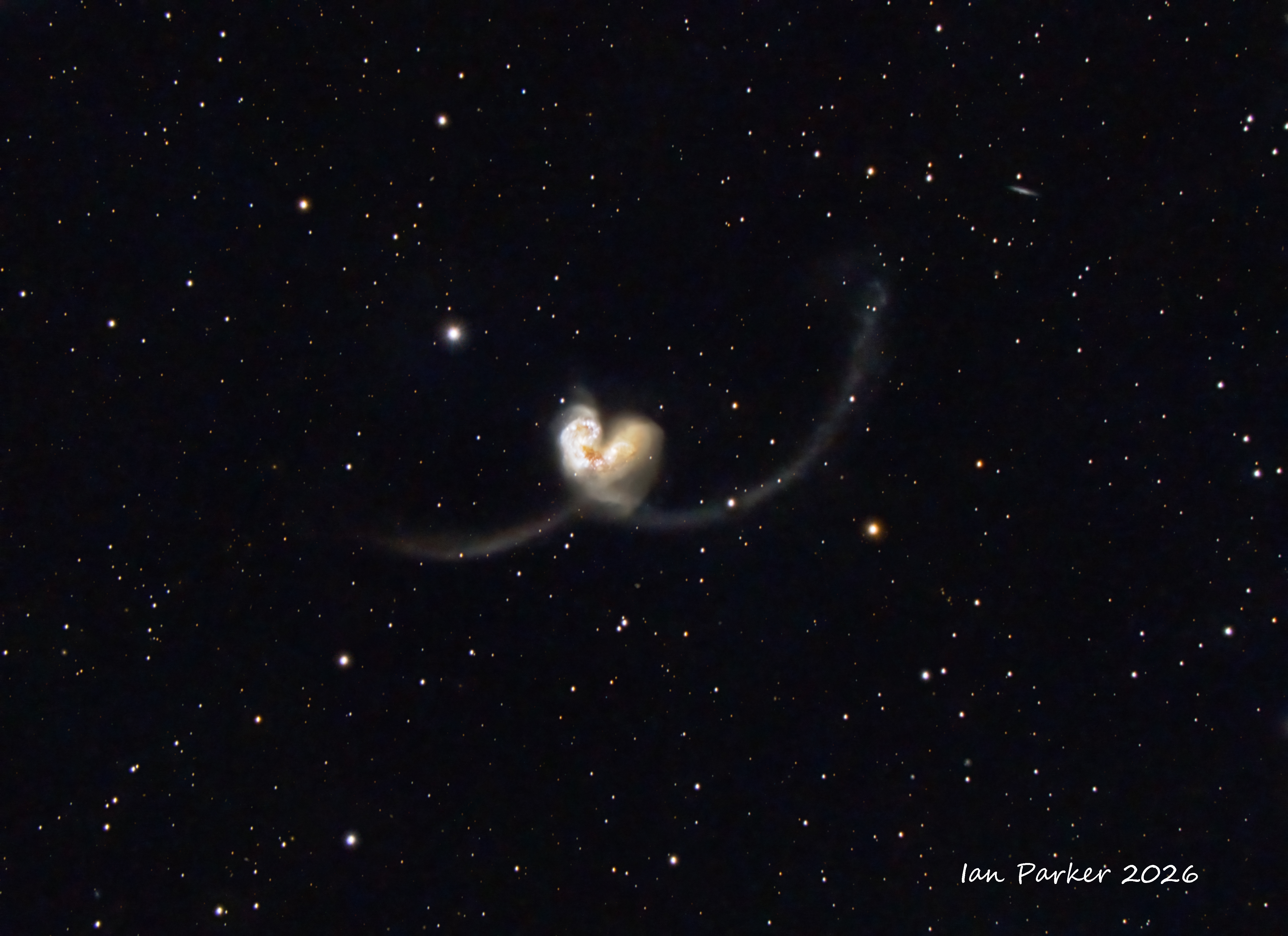
It’s springtime now, which for astrophotographers means it’s galaxy season. At this time of year, the orbit of the earth around the sun places our night sky looking away from our galaxy, the Milky Way. Consequently, there is a dearth of the large, colorful nebulae that are fun targets to image in the Milky Way. In compensation we get an unobstructed view of the cosmos and the more than 2 trillion galaxies thought to be present in the universe. Of course, almost all of these are too far away and appear too small to be resolved by modest amateur telescopes; but that still leaves enough targets to keep an astrophotographer occupied for many years. Among them are my favorites - instances where two (or more) galaxies are colliding with one another, as in the two photos I highlight this month of the Heron Galaxies and the Antennae galaxies.
Intuitively, collisions between galaxies might be expected to be rare given the scale of the universe. However, galaxies typically exist in groups held together by gravity where most galaxies probably undergo at least one significant collision in their lifetimes. When two galaxies pass close to each other, their gravitational pull causes them to warp and eventually fall into a spiral, interacting and distorting to eventually merge over hundreds of millions of years. Individual stars rarely collide due to vast interstellar distances, so the merger of two galaxies is more like two swarms of bees passing through one another. However, gas clouds from interacting galaxies do collide, compressing them to spark intense star formation as a starburst region of new stars. When a starburst region is created, the galaxies fall back into each other, eventually merging into one galaxy but only after multiple passes through each other. This creates "tidal tails" of stars, gas and dust stripped from the galaxies. Many (if not all) present-day, large galaxies are thought to have grown from smaller galaxies that collided and merged. Studying nearby collisions helps astronomers understand how galaxies evolved over the universe's history and provides insight into our own spiral galaxy's future collision (in 4–5 billion years) with the large, spiral Andromeda Galaxy.
Colliding galaxies are my favorite galactic objects to image. At one level they simply make for interesting pretty pictures! Considered as abstract artwork, the tidal tails resemble sweeping brushstrokes, and with the right orientation the galaxies mimic the nicknames they have been given; here, an erect heron (top), and insect antennae (below).
On a very different level, I try, and fail, to envisage the scale of what is represented in these images. The Antennae galaxies are one of the closest pairs of colliding galaxies to us, but still lie 65 million light-years away, meaning that we are seeing them 65 million years in the past. And they are still merging! The galaxies are thought to have passed through one another some 900 million years ago, but will not completely merge for another 400 million years. Each component galaxy contains hundreds of billions of stars, many of which will have planets compatible with life. Statistically (the Drake equation), there is a good likelihood of at least one extraterrestrial civilization within my pretty picture. And this is just the Antennae galaxies themselves. Deep space images typically show other far-away galaxies, appearing tiny in the background behind the main subject. My images hardy match the famous Hubble and James Webb “deep-field” images, but you can clearly see an edge-on galaxy above and to the right of the right “antenna”, and more can be found if you download the full-resolution photo by clicking on the image above.
|
February 2026 Witch Head Nebula
|

IC 2118 The Witch Head Nebula
IC 2118 is a large but very faint reflection nebula in the constellation Eridanus. It is believed to be an ancient supernova remnant or gas cloud, illuminated by nearby Rigel, a blue supergiant star about 85 times more massive than our Sun. Although the nebula is said to look suspiciously like a fairytale crone, hence its familiar name of the Witch Head Nebula, I have a hard time seeing the resemblance myself. Maybe if you rotate my photo 90 degrees clockwise and imagine the witch looking to the left.
Several features make the Witch Head Nebula a challenging target for an ameteur astrophotographer to image. One is that its large size needs a wide telescope to capture the entire object in the frame. As with my previous month’s photo, that made it a good subject for my new RedCat51 telescope with a focal length of 250 mm. Beyond that, the nebula is very dim, illuminated by light reflected from Rigel, showing a blue color arising not only from the color of the star, but also because the interstellar dust grains reflect blue light more efficiently than red. This makes it an impossible target for me to image from home, where our massively light-polluted sky would swamp the faint blue. Unlike emission nebulae that emit light at very specific wavelengths that can be isolated by narrowband filters, the broadband reflected starlight cannot be similarly isolated from moonlight and light pollution. The Witch Head Nebula was thus on my list of targets for one of our new-moon expeditions to dark sky sites in the desert.
In addition to lack of light pollution, things I consider when selecting a remote site for astrophotography include weather (likelihood of clear skies, day and nighttime temperatures etc.) and whether there is something interesting to do during the daytime. My photo this month was taken in the KOFA National Wildlife reserve in southern Arizona, a remote area, shown at Bortle class 2 on the light pollution map. As well as providing dark night skies, the reserve is a beautiful place to explore 4wd trails through the rugged mountains. On this trip in January I was participating in a virtually-organized ultramarathon race that involves covering 267 miles during the month. I logged some of those miles along the steep up-and-down trails toward a successful completion of the race as third-oldest finisher.
|
January 2026 "Spaghetti Nebula"
|

Sh2-240 The Spaghetti Nebula
[RedCat 51; AM3; ASI air, EAF, OAG; 159 x 300s subs, Optolong Extreme Ha/OIII filter]
Supernova remnants (SNRs) are my favorite and most aesthetically interesting cosmic targets to image. As the name indicates, they are what is left over after a supernova; the expanding, glowing cloud of gas and dust left behind after a massive star explodes. There are two common routes to a supernova: either a massive star may run out of fuel, neutron starceasing to generate fusion energy in its core, and collapsing inward under the force of its own gravity to form a or a black hole; or a white dwarf star may accrete material from a companion star until it reaches a critical mass and undergoes a carbon detonation. In either case, the resulting supernova explosion expels much or all of the stellar material with velocities as much as 10% the speed of light ~ 30,000 km/s) and a strong shock wave forms ahead of the ejecta. That heats the upstream plasma up to temperatures well above millions of K. The shock continuously slows down over time as it sweeps up the ambient medium, but it can expand over hundreds or thousands of years. On a cosmic timescale SNRs are thus very brief events and may show visible changes even on a human timescale. For example, the Crab Nebula results from a supernova observed by Japanese and Arab stargazers in 1054, and images of the Crab Nebula SNR taken only 15 years apart show its continuing expansion.
A supernova remnant is bounded by an expanding shock wave, and consists of ejected material expanding from the explosion, and the interstellar material it sweeps up and shocks along the way. The roughly symmetrical expansion results in SNRs appearing roughly circular in outline, with intricate filaments and loops generated by the shock fronts. The light that is emitted originates primarily from ionized hydrogen (red) and oxygen (blue/green) gases, which is an advantage for imaging as these specific wavelengths can be isolated by narrowband filters to largely block contaminating moonlight and light pollution.
Perhaps the easiest SNR for an amateur astrophotographer to image is the Cygnus Loop (Veil nebula). This is a large, relatively bright nebula, which I had photographed last summer when it rises high in the sky. Next on my list was the Spaghetti nebula (Sh2-240), an aptly named tangle of filamentous loops reminiscent of the Cygnus Loop in terms of distance and age. It's a bit farther away, a bit older, and a bit larger physically than the Cygnus Loop, but the biggest difference is the much lower surface brightness. I was able to image the Cygnus Loop through the light pollution at our home near Los Angeles, but for the Spaghetti nebula I had to wait until I could get out to dark skies in the desert during a winter new moon when it would be rising high. As well as being faint, another challenge was the apparent size of the remnant, covering a full three degrees of the sky, equivalent to the width of six full moons. Neither of my telescopes would fit all of this in a single frame, and assembling a mosaic of individual exposure panels would be a daunting task.
A more fun alternative was to succumb to the temptation to buy a new telescope! So, my photo above is first light with my Christmas present, a RedCat51 telescope, a small, elegant example of optical engineering with a focal length of 250mm that (just) encompasses the Spaghetti nebula. I captured the photons to generate the image over two nights camped out in Anza Borrego State Park, a dark sky location with pleasant nighttime temperatures in winter and the advantage of good pizza and ice cream in the nearby town of Borrego Springs.
|
November 2026 "Medulla and Dolphin Head"
|

CTB1 Medulla Nebula

Sh2-308 Dolphin Head nebula
For this month I feature two cosmic nebulae that are of similar “bubble” shape. They appear of similar size as viewed from the earth,each about the width of a full moon, and both are fleeting events on a stellar timescale. However, they originate through different celestial mechanisms and show contrasting colors and. Both are emission nebulae, where the light is generated by fluorescence of gases ionized by ultraviolet light from stars. The predominant interstellar gases are hydrogen, which emits in the red at 656.33 nm, and oxygen which emits in the blue/green at 500.7 nm. I used a special dual narrowband filter that isolates light from the very specific wavelengths of hydrogen, and oxygen to produce these photographs. These are depicted here in “natural” colors, although many astrophotographers prefer to depict hydrogen in yellow and oxygen in blue for scientific or aesthetic purposes. Both the Medulla and Dolphin Head nebulae are very faint and required long exposure times to image, aided by the use of the narrowband filter which drastically attenuates light pollution and by venturing to dark sky locations in the California desert.
The upper photo shows the Medulla Nebula - CTB1, named for its resemblance to the brain structure though sometimes also called the garlic nebula. It is about 140 light years across and 14,000 light years distant. The Medulla nebula was discovered in 1955 by George Abell, who mistakenly cataloged it as a planetary nebula, giving it an alternate designation of Abell 85. It is actually an extremely faint expanding gas shell that was left when a massive star toward the constellation of Cassiopeia exploded about 10,000 years ago. The star likely detonated when it ran out of elements near its core that could create stabilizing pressure with nuclear fusion. The resulting supernova remnant, still glows in visible light by the heat generated by its collision with confining interstellar gas; primarily hydrogen, hence the predominant red coloration.
The lower photo shows the Dolphin Head nebula, SH2-308, a beautiful bubble-like nebula composed of ionized oxygen and hydrogen, surrounding a Wolf-Rayet star, EZ Canis Major. The nebula is approximately 60 light-years across at its widest point and 4,530 light-years away from Earth. Wolf-Rayet stars are in their very brief, pre-supernova phase of the stellar life cycle. They are very large, hot, and bright, putting out enormous stellar winds that shock the surrounding interstellar gases into interesting shapes. The Dolphin Head nebula was formed about 70,000 years ago by the star EZ Canis Majoris throwing off its outer hydrogen layers, revealing inner layers of heavier elements. Fast stellar winds, blowing at 3.8 million mph from this star, created the bubble-shaped nebula as they swept up slower moving material from an earlier phase of the star's evolution. The oxygen composing the nebula is ionized by intense ultraviolet radiation from the Wolf-Rayet star at its center giving a predominantly green/blue color, though some hints of red are visible from ionized hydrogen. The star will eventually explode into a supernova, thereby subsuming the existing nebula and creating a new supernova remnant like the Medulla nebula. . |
September 2025 "The Suid and the Flying Bat"
|

Flying Bat (Sh2-129) and Squid (Ou4) Nebulae
Canon 400mm f4 DO lens, ASI 2600 MC Pro camera, dual narrowband Ha/OII filter (Optolong eXtreme), ZWO AM3 EQ mount, 74 x 300s subs. Bortle 1-2 sky at Mono Lake
The hobby of astrophotography is invariably characterized by its participants as being extremely frustrating! On a given night everything has to work properly with the equipment, but more importantly, the sky needs to be clear. Living near the coast in southern California I have been harassed this summer by an overcast marine layer that formed most evenings after perfect blue skies during the day. It is frustrating when the photons from a desired nebula have travelled unimpeded for several thousand years through space only to be interrupted microseconds before reaching my telescope! The few clear nights are thus precious and deserve some thought as to what deep sky object to target
.
Unlike landscape photography where you have to travel to what you want to photograph, nebulae and galaxies are arrayed across the night sky so it is just a matter of deciding where (right ascension and declination) to aim your telescope. There are seasonal changes in what is visible (for example, in the northern hemisphere winter is “nebula season” and spring is “galaxy season”) but on any given date there are hundreds of potential targets within the capabilities of an amateur telescope. How then to choose between them? At home, under highly light-polluted skies (Bortle 8-9) I am largely limited to imaging emission nebulae, which emit light from ionized hydrogen and oxygen gases at highly specific wavelengths that can be selectively passed by narrowband filters while strongly blocking light pollution and moonlight. My criteria for choosing which nebula to image include their aesthetic interest and technical difficulty. Sometimes an easy (bright) target is a good choice, particularly if the cloud forecast suggests that imaging time might be short. On the other hand, as a beginning astrophotographer, I sometimes like a challenge to see how my skills are improving
.
My photo this month - the Flying Bat and Squid Nebulae – fulfilled both criteria. It encompasses a larger red, ionized hydrogen nebula (the Flying Bat; Sh2-129), and a green/blue ionized oxygen nebula (Ou4) that really does resemble a squid. By itself, the Flying Bat is rather diffuse and uninteresting; but the intriguing juxtaposition of the Squid greatly enhances the aesthetics and provides the technical difficulty. Remarkably, the Squid was only recently discovered in 2011 by amateur astronomer Nicolas Outters (hence the designation “Ou” in Ou4). It is thought to arise from a bipolar outflow from the bright blue star at its center, but the Squid itself is VERY faint, explaining why it was only recently discovered, and why it represents a difficult target. Indeed, there are many accounts in online astrophotography forums of people being defeated in their attempts to image the Squid.
To improve my chances, I waited to image this target until we traveled to a dark sky site (Bortle 1-2) to eliminate even the small amount of light pollution that would escape through my dual narrowband filter when imaging at home. I accumulated six hours of exposures with a color camera (72 exposures of 5 minutes), using a “big white” Canon camera lens as it has a wider field of view for encompassing this subject and captures more light than my telescope. The Squid was not apparent in my first individual exposure, so I just set the camera to run through the night in the hope of a good result in the morning. After aligning and integrating all the exposures I removed the stars and generated separate channels for the red and blue-green signals from hydrogen and oxygen, being relieved to see the Squid clearly visible in the latter, albeit faint. To produce the final image I colorized the channels after applying strong noise reduction, masking, and stretching to balance their brightness, finally .recombining the channels and adding back the stars,
|
February 2025 "Aurora over Mt. Otertind, Lyngen Alps, Norway"
|

Aurora over Otertind Mountain; Lyngen Alps, Arctic Norway
My photos for this month and last month were taken on two recent, almost back-to-back trips to very different locations and environments; to the heat and chaos of India for people photography at the largest gathering of humanity on the planet, and to the solitude and crisp arctic air of northern Norway. Although the two photos are vastly different, they nevertheless share a common theme in that both feature atmospheric phenomena – trails of smoke exhaled by a sadhu smoking a cheroot and, on a much larger scale, aurora evoked as a coronal mass ejection hits the earth.
The solar cycle is now approaching a maximum. In anticipation of seeing auroral displays Anne and I had travelled to Iceland last winter, but with little success. This year our destination was arctic Norway (Senja island and the Lofoten islands), locations situated right under the oval of auroral activity. Along the way to Senja island we stopped for two nights at Nordkjosbotn, a small town among the Lyngen Alps on mainland Norway, staying in a lodge called Vollan Gjestestuein that made for a cozy basecamp, and served excellent smoked salmon every morning for breakfast. A highlight of the Lyngen Alps is the view of Otertind, a stunning 4000ft mountain peak with iconic dual, jagged summit peaks. On our first afternoon we reconnoitered the approach to the mountain, driving gingerly on a snow-covered gravel road down the Signal River valley that runs along its base. However, the forecast that night was for 100% cloud cover, so we got a good sleep after a diner of traditional Norwegian salted cod stew (bacalao) at the lodge.
Forecasts of auroral activity looked promising the next night. Although the day dawned overcast with light snowfall, there was a chance of a weather window after dark. To check cloud forecasts, I had discovered Ventusky, a website that provides images of predicted cloud cover at one hour intervals with amazingly fine granularity. This showed a local clearing over the mountain anticipated to last from about 9pm to around 11pm. We thus set off after dinner, aiming to reach a viewpoint for Otertind before the cloud cleared. However, problems navigating a tangle of small tangle of roads revealed that our reconnaissance was inadequate, and by the time the mountain came into view the clouds were clear and a spectacular auroral display was already underway.
For next couple of hours the sky was lit up by constantly changing bands and explosions of auroral patterns. Many of these conveniently lined up behind Otertind from our viewpoint, while others appeared directly overhead. By eye the aurora appeared bright green, but the camera further picked up sheets of contrasting red/magenta glow. During these two hours I was constantly taking exposures and changing perspectives to follow the displays as they moved around the sky. The photo here is just one example of an amazing diversity of the patterns that appeared. (Keep checking back on my website for many more to come…)
I photographed the auroras using a Canon R5 camera fitted with an 11 mm f4 Irix lens. Auroras span across wide swaths of the sky, and even with this super-wide lens I often could not fully encompass the displays. Another consideration is that auroras change rapidly, Long exposures thus result in blurred images, losing the sharp striations and fine details often present in the sheets of glowing light. Deciding on an optimal exposure time is thus a compromise between sharp, but noisy images with short exposures versus cleaner, but blurred images with longer times. Of course, the brighter the aurora the easier this becomes! Taking advantage of the low noise of the Canon camera, and AI noise reduction software I used a manual exposure of 4s at ISO 3200 with the lens wide open at f4.
Next winter we plan another arctic aurora-hunting trip, and for that I will be tempted to buy a new Laowa 10mm f2.8 lens, that woul give an even wider field of view and capture twice as much light… |
|
|